Pulling at my sleeve Aman crouched behind a tree stump. “Get down!” he whispered, looking at me earnestly. “They’ve spotted us.” His head leaned forward, eyes popping out, trying to communicate the urgency of the situation.
I crouched beside him, not fully sure of myself.
“So.. what do we do?” I asked after a few seconds. “We have to move slowly, okay? .. or they’ll start throwing coconuts!”
We crept behind a nearby bush, peeking out like spies.
Somewhere above us we heard the sudden and loud chatter of monkeys. Aman gasped. “They’re planning an attack.”
For the next half-hour, we dodged, whispered, crouched, climbed, and narrowly escaped the ‘attack’.
As remembered by Aastha
Thanks for reading! Subscribe for free to receive new posts and support my work.
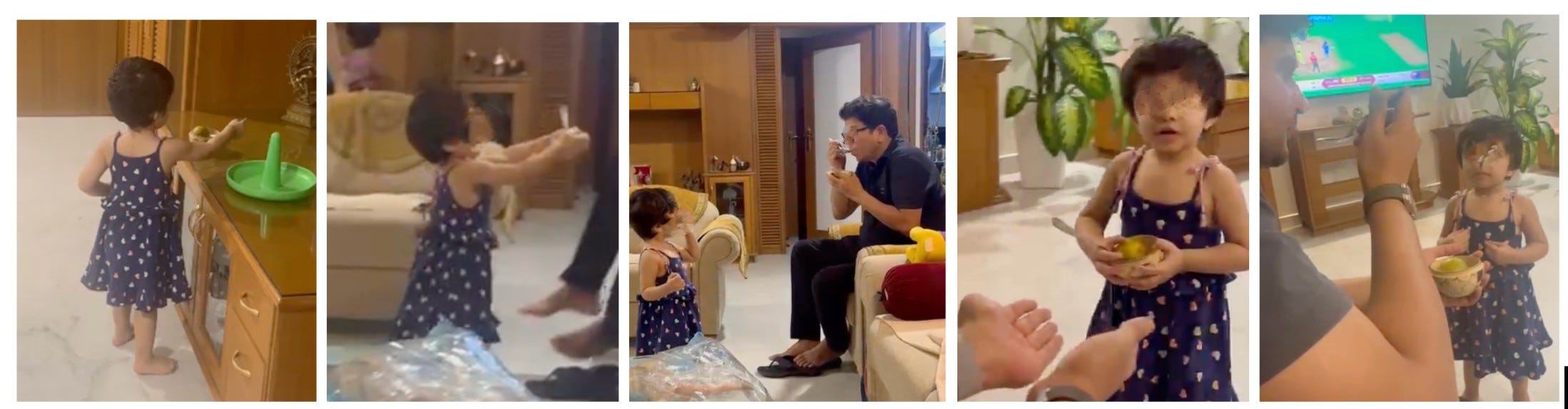
During a recent family gathering my 2-year-old niece walked around with a “bowl” made from half a Russian doll and a lemon inside it - stirring, waiting as she set it on the table.
Her grandma immediately said: “Oh, you’re making soup,” and she nodded slightly while her eyes were set on the bowl, stirring.
“Garam thai che,” she said - it’s getting hot. The table had become her induction stove.
She picked up the “bowl,” walked to an adult, and warned softly, “Garam che, dheeme dheeme” - “It’s very hot- please drink slowly.”
Then she rushed back to make another batch: “One minute… no, two minute - it’s getting hot.” She kept stirring, serving, and repeating.
One by one, the room put conversations aside and joined her - pretending to sip, taking turns, following her lead. It was small and beautiful - garm che, dheeme dheeme. Even the investment and cricket talk slowed to make space for her play.
Reflecting on these moments with children made us realize the beauty of stepping into a child’s world. For that brief period in time, the adults around the child entered a state of playfulness that involves physical movement, the suspension of reality, and an opening of the mind and heart – ways of seeing and being that adults too often forget.
Perhaps, this is why workshops on childhood and education often begin by asking adults to recall a time from their own childhoods where they were playing. Having conducted such workshops ourselves, we recognise the power of these memories. Perhaps, reader, you too would like to take a moment to pause and recall a childhood memory of your own. The prompt immediately carries adult participants to a different time and place, far from their current realities. Childhood, for most of us, was a period in which we held the constraints of reality loosely and allowed our imagination to lead us. However, as adults, in a fast-paced, outcome-driven world, we often forget what it means to see the world this way.
Curious about this adult-entering-play phenomenon, we looked up the phrase ‘invitations to play’. Strangely, most of what we came across were responses to the question ‘How can adults, specifically educators, design play-based/ playful learning environments for children. Even though play is something we typically associate with children and childhood, in the context of learning and education the narrative somehow flips. In play-based learning, the focus is often on the educator’s ability to choose, arrange and offer materials, spaces and prompts that act as provocations for play for children.
However, while reflecting on these stories (the ones at the start of this post), we found ourselves asking a different question ..about the invitations of play that children present to us. We wondered what would happen if instead of making adults responsible for staging the perfect conditions for a child’s play, what if we were to shift the focus to enabling adults, instead, to join children in their magical worlds.
Entering child-mode
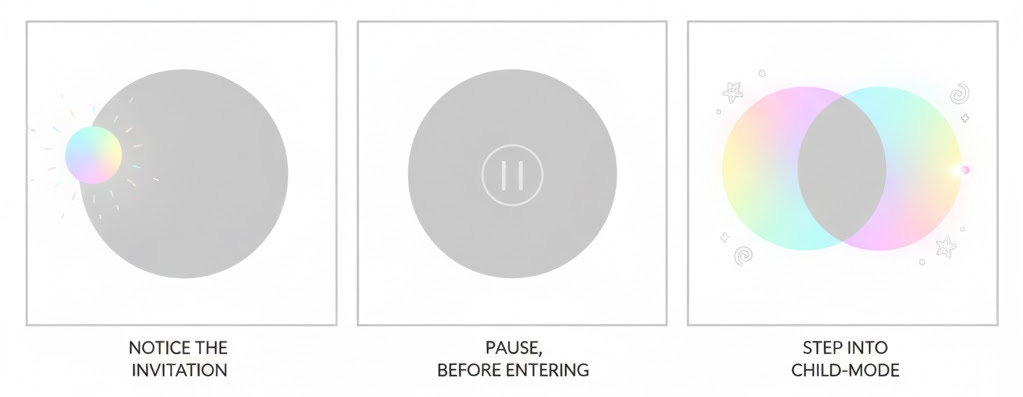
If we zoom in on them, most informal interactions between a child and an adult seem to move through a three step process.
First, there is the child’s invitation.
Any adult who’s spent time with a child has heard the phrase “Do you want to play?” more times than they can count. Sometimes we hear it so often that we almost tune it out.
That is the loud, obvious form of their invitation: “Come play with me.” “Can you do this?” “Let’s go there.”
Sometimes it’s less obvious, a made-up scenario, an unusual question, a prop being offered, a space being made.
In these moments, children are actively engaged in a world of their own making. Those worlds, although ‘imaginary’ are very real to the young mind that is still constructing an objective understanding of reality. And through their little invitations, they’re opening up a portal for you, the adult, to enter that world and to build it, with them.
The invitation doesn’t always land. In the off chance that it does, next comes the adult’s pause.
In that split second, there is often an awkward tension inside us: How should I respond? Do I play along ..do I turn this into a lesson ..or do I laugh it off? This pause is where an adult decides, even briefly, to put something down: to hold off on judgement, to suspend the need to explain, and to join within the frame the child has already set.
In Aman’s case, the adult could easily have slipped into explanation-mode, talking about gravity, and why coconuts fall, about how the world “really” works. Instead, she chose to hold off for just a few minutes. That choice is difficult. Entering child-mode asks us to be a little silly, a little vulnerable. It exposes us to being judged - by others, by ourselves. Sometimes we may even feel a kind of laziness: the sense that this kind of engagement will take far more energy than just staying in control.
To stand in that pause and not rush to the safety of knowing or explaining, correcting or directing takes effort. But once I’ve paused, and let go a little, I’m suddenly more available. There is a small inner click: Que sera sera (whatever will be, will be).
Finally, the adult enters child-mode, a state of playfulness and whimsy.
In child-mode, the adult is not being playful for the child’s sake. We are actually playing. We’re actively exploring how this ‘other’ world works and conversely we are actively involved in building it. We can no longer rely on what we think we know, we must find out afresh: what is and is not, what we can and cannot, what we must and must not.
There is a sense of flow and a softening of self-consciousness. We’re no longer trying to secretly steer the moment towards a learning outcome or a life lesson from the outside. We’re now within it and it now looks very similar to what researcher, Dr. Peter Gray, describes as play; self-chosen, intrinsically motivated, ordered by the player’s own rules, and imaginative. It is held in a mental space where the activity matters deeply inside the moment but carries no heavy consequences outside it.
For many of us as adults, this is rare. We’re used to planning, guiding, fixing, teaching. Child-mode is different. It asks us to join the child’s world on their terms and to discover that, in doing so, something in us begins to play again too.
What child-mode opens up
Child-mode begins with an invitation to play, but when an adult decides to enter child-mode, it opens up a possibility of something deeper. It allows you to empathize with the child, understand them better and make space for the child’s intent, even in the most ordinary moments of everyday life.
In early childhood research, this kind of back-and-forth is sometimes called “serve and return” – a child serves an action or expression, and the adult returns with attuned attention. To us, child-mode feels like one small, everyday way of practicing that attunement
This shift doesn’t always come naturally. It takes attention, practice and sometimes, it takes seeing it unfold over time to really understand what it makes possible.
As remembered by Aastha
Let me tell you about a transformation I’ve seen unfold over time.
A few years ago, my cousin Priya, a mother of two - messaged me in frustration about her 8 year old daughter, Pahel.
It had been a long day - school, snack, shower, and a dance class coming up. Pahel had slipped into her own rhythm in the bathroom, dancing under the shower, singing to herself, playing with the soap. Meanwhile, her mother stood outside, trying to hurry things along. “It’s already 5:10. We’re going to be late.” When Pahel finally stepped out, she was still humming. She walked to the mirror and continued dancing in front of it, completely in her own world.
Priya messaged me: “She’s so irresponsible. She just doesn’t get it. Even when we’re getting late, she’s still playing.”
I remember reading that message and replying, “She was dancing in front of the mirror. Isn’t that beautiful?”
But she couldn’t see it that way at that moment. She was tired. She was managing time, transitions, emotions, the pressure of being everywhere at once. And in that space, it can be hard to notice the joy that’s unfolding right in front of you.
The second moment happened a few years later. Priya has been a pre-school teacher for 2 years, working with children daily. This time with her younger daughter, Kia.
We were all sitting around the dinner table, eating bhel - a puffed rice dish with chutneys, vegetables, and spices. It’s something you usually mix just before eating. Priya, trying to help, quickly mixed Kia’s bhel bowl.
But as soon as she did, she shouted, “Nooo! I didn’t want it mixed!” She folded her hands, made a face, and said firmly, “I won’t eat it.”
We all have seen moments like this. In the past, a moment like this could have spiralled. There might have been scolding. A child eating through tears. An adult feeling helpless and unheard.
But this time, I saw Priya pause. She just watched Kia and tried to understand what was going on. Maybe her daughter had a plan. Maybe she wanted to eat things one by one. Maybe she had imagined her bowl in a certain way, and the mixing interrupted that.
Priya picked up a spoon and said, gently, “Whichever bowl you put the spoon in, that one’s yours. Which one?”
Kia smiled, got excited. And everyone returned to their bowls!
That’s what child-mode can open up!
We sometimes wonder what enabled that shift in Priya. Her response didn’t involve ‘giving in’ or pandering to a tantrum. She simply turned what could have been a stressful moment into a moment of play that connected her to her daughter.
Maybe this is why grandparents are always willing to go the extra step for the little ones. Spending twice the time making a paratha, just to shape it into a star. In that moment, the grandmother is weighing her effort against the connection it forms between her and the child - and choosing the latter.
That’s the heart of child-mode.
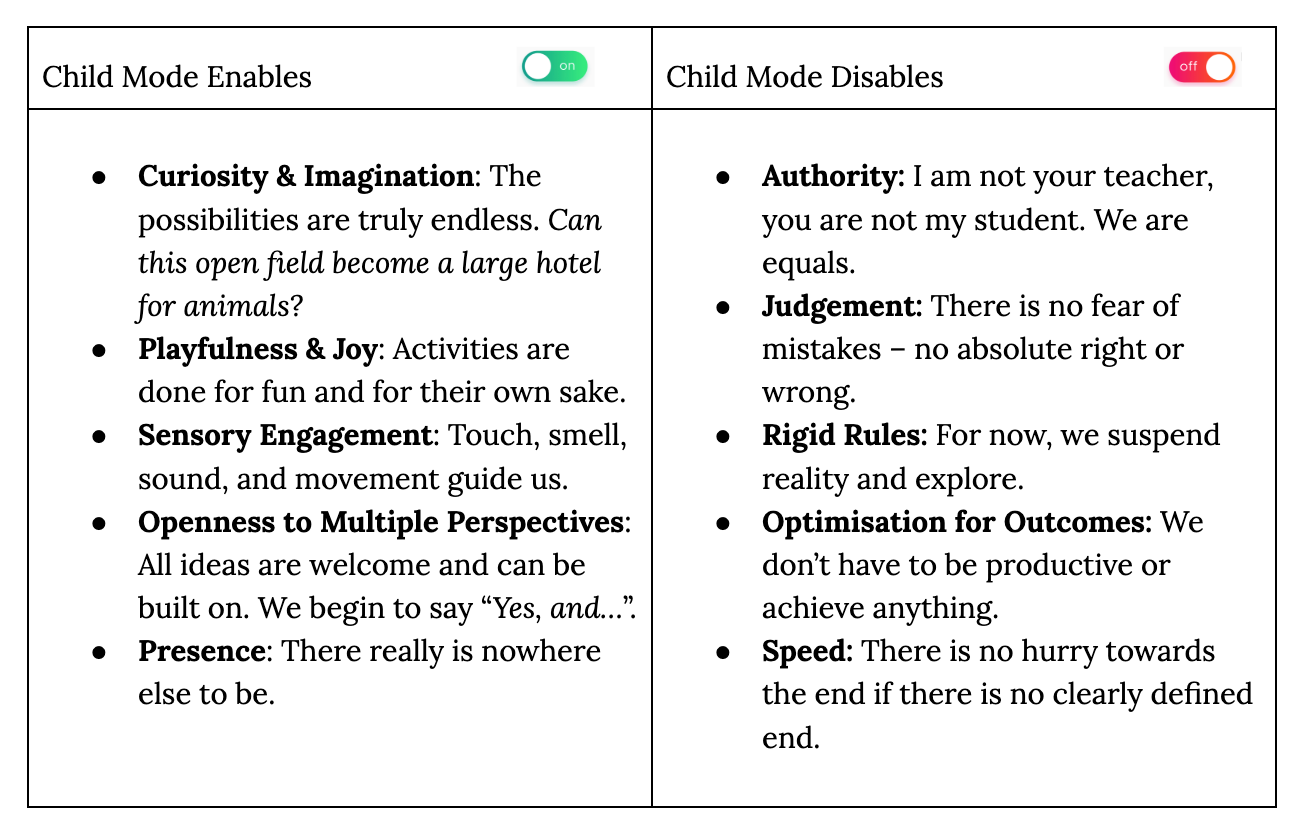
Imagine child-mode as a switch or a button, like the ones on our phones that allow us to enter airplane mode. Airplane mode shuts down the network on your device, cutting off the noise and clutter of the outside world. Similarly, child-mode too allows you to set aside your authority, judgement and rigid rules making space instead for curiosity, imagination, playfulness and joy.
Just like anything else, entering child-mode too requires intentional practice. The more frequently we press the pause button and enter child-mode, the easier it becomes each time. Instead of a triggered response, the adult experiments with creating a new access point between themselves and the already playful child. Over time, this leads to fewer tears, fewer power struggles, and more moments where adults and children are on the same side.
Gradually, the journey from adult-mode to child-mode becomes more second nature and flows into all aspects of life. Perhaps, it leads to a gradual release of tension and stress in other aspects of life too. If we can learn to play with children, perhaps we can play for our own sake too.
Thanks for reading! Subscribe for free to receive new posts and support my work.