Typically, our Leaves in Pocket posts begin with children - Nachiket, Saanvi, Baadal, and all the big and small questions they leave us with as they move through the world. That has been the heartbeat of The Observation Project: to learn about learning by staying close to children, and letting their gestures, choices, and unexpected logics teach us what our adult frameworks often miss.
This one begins with an adult, not because we want to put him on a pedestal, but because speaking with him made us curious in a different way.
Ikpreet Singh is an artist and educator who runs a weekend art space for children in his neighborhood. As we discussed his work with him, we noticed that he rarely spoke about his own actions. Instead he gushed with stories about children, sharing pictures of their artwork with detailed explanations. This left us wanting to stay longer and look closer at his practice - the choices he makes, the moments he notices, and the kind of learning his room makes possible.
As remembered by Ikpreet Singh (Artist & Educator)
Anika’s first class at Ikpreet’s Art Space
On her very first day, Anika (7 years old) walked in with visible excitement. She had previously attended an art class and proudly carried her drawing book with her. She was eager to show off what she already knew and equally curious to see what new things she would learn.
Anika's drawings from her previous art class
We began the class with a prompt:
Imagine you could be a thing for one day. What would you be? What would you look like? What would you be able to do and why?
..an additional clarification for Anika: Today, there would be no reference. No picture to look at, you have to draw what you imagine.
Her reaction was pure shock. “How will I make something then?” she asked, genuinely confused. This was perhaps the first time she was being asked to create without a reference to rely on.
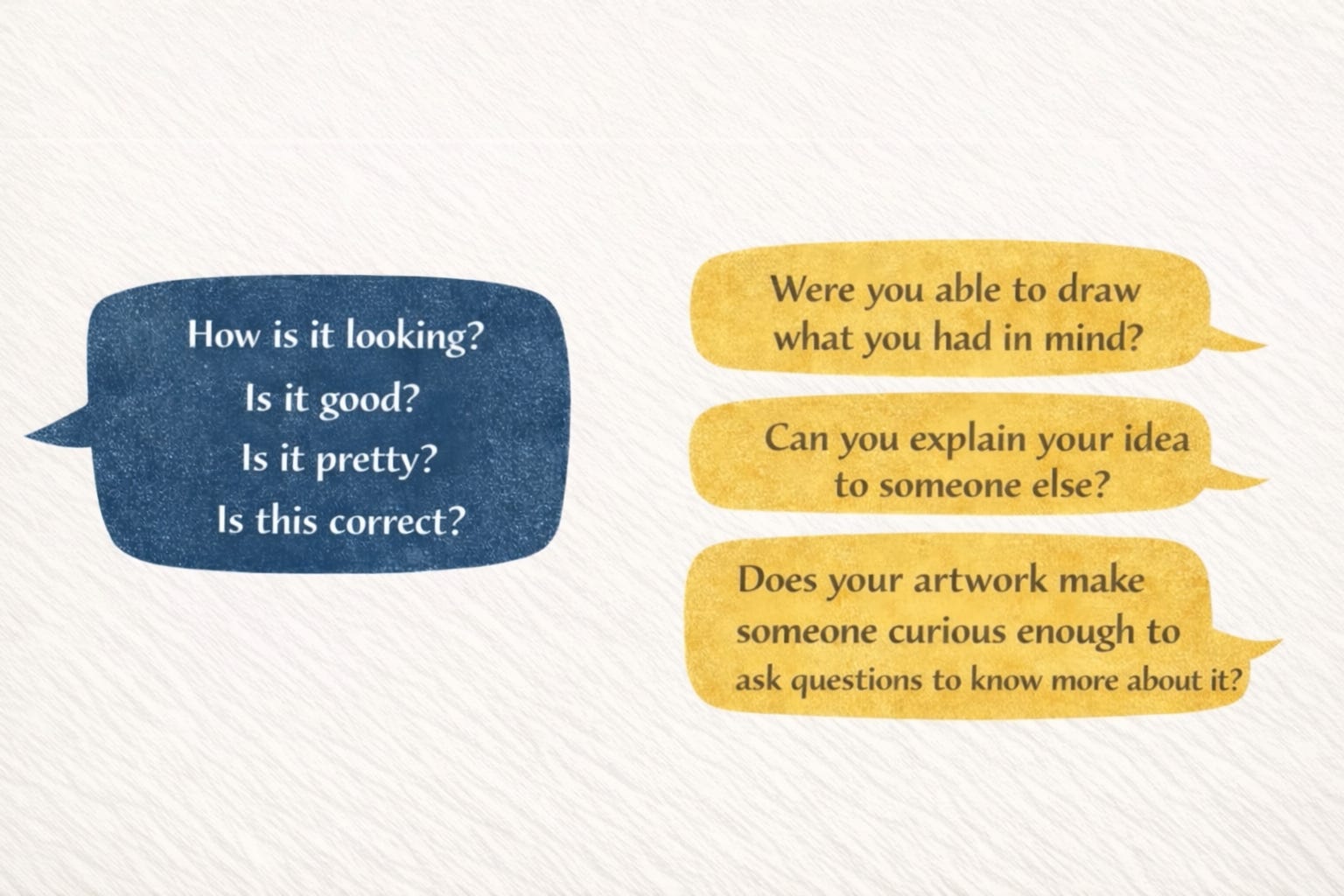
We decided to try anyway. I shared a few ways to begin thinking before drawing, how ideas can come first, and how simple shapes we already know can be reused to create something new. She attempted to draw..however, she continued to be in the dilemma.. “Will it be good? What if it isn’t as good? How do I know if it’s good enough?” - Every 5 minutes, she kept asking me ‘how’s this looking?’
Using what she already knew, she managed to put something on paper.
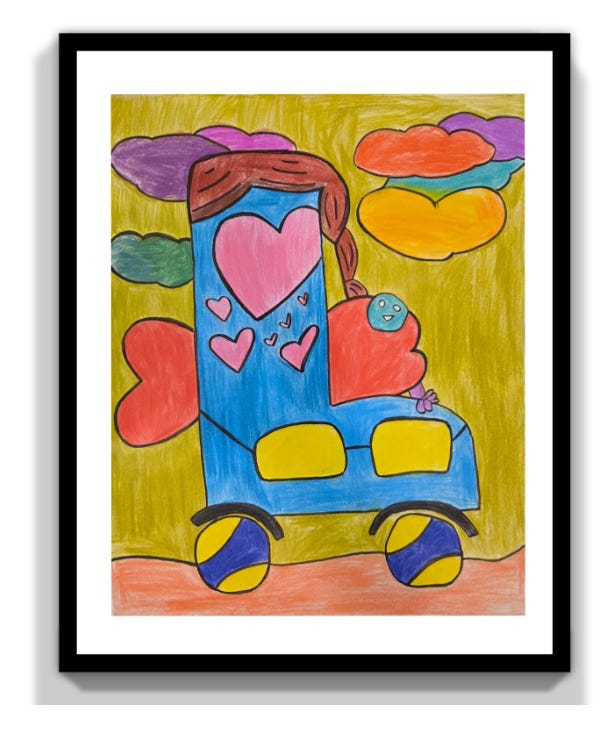
Her artwork depicted her wish to be a skater with a nice hairstyle.. wearing cool sunglasses.. hearts all around her.. surrounded by clouds.
Anika’s creative artwork expressing her wish to be a skater
But when she looked at the final outcome, she was not happy. It did not look as neat or symmetrical as her earlier drawings. This did not match her idea of what good art looked like.
I genuinely felt that she had not enjoyed the class much and wondered if she would return next week.
The next week, Anika returned…she continued to ask the same question multiple times ‘how’s this looking?’ and am I correct?
It took a few weeks for her settle in the new format of art class.
A few weeks into the class, my prompt for her was…to portray a special moment from your life...Anika immediately chose her birthday. She first struggled to turn the celebration into a portrait, but after careful thought she depicted herself with the cake’s layers flipped upside down to form her hair. A pineapple, her favourite flavour, becomes one eye, while other party decorations shape the rest of her face.
Anika’s birthday portrait - cake as hair, pineapple as an eye.
Over the next few sessions, she started creating more freely. She began experimenting and adding her own ideas into her work. She wasn’t yet confident, she wanted reassurance and validation. Yet, that one question stayed constant: “How is it looking?”
I never answered that question directly. Not because the question was wrong, but because the answer she was seeking would pull her back into judging her work through symmetry, neatness, and appearance. Instead, I would ask her different questions.
It’s been 1 year that Anika has been interacting with me in my art space. Finally, I see gradual change in her that her interactions with me are less about ‘How’s it looking?’ to ‘Look, I made this’. She has now moved passed the need for a reference to copy and very confidently explains what she’s made. She owns her artwork and takes pride in it!
Very recently, Anika imagined designing her room, she created a magical, highly interactive space filled with wonder, play, and imagination. Her room has special buttons that bring different bats, clouds, cartoons, and even space within reach, along with a magical mirror that can answer any question. There are secret connections that allow her to travel instantly to jungles, palaces, Hampi, school, or even outer space just by pushing, touching, or placing her hand in certain spots. Cartoon characters like Doraemon can come alive and play with her, snacks appear whenever she wants them, and a friendly ghost named Lily Chudail keeps her company!
One year into the class, Anika imagines her magical and highly interactive bedroom
0:00
-2:37
Anika explaining her artwork in Hindi - hear the confidence and ownership in her voice..
Anika’s story tells us the tale of perhaps all of education and learning. From an early age, children are trained to pursue perfection in how they seek, interpret and articulate their knowledge. Strangely enough, we see this pattern replicated even in so-called ‘creative’ pursuits such as the arts
Unlike the open-ended prompts that Ikpreet uses to kick off his classes, art classes typically begin elsewhere. Perhaps from an object, to draw and replicate or a scene to represent accurately from memory. Inherent to this kind of prompt is a pursuit of perfection - in symmetry, in colour, in aesthetic. Yet, speaking to Ikpreet one realizes that these, although critical, are hardly his priority. Cautiously, he refrains from calling his sessions with children ‘art classes’. Instead, he refers to them as a space for children to come hang out, explore, dialogue, debate and express themselves.
For Ikpreet, his relationship with art is deeply personal.
Ikpreet on his relationship with Art x Education
For me, art has always been personal. As a child, I painted on and off. I didn’t really chase technique, but the feeling of making something truly excited me. Years later, art returned to me through sports. I began drawing sporting moments not to capture them perfectly, but to show how I saw them - and once an idea is on paper, it invites conversation, disagreement, and connection.
Ikpreet's art about sporting moments
On the other hand - Learning, for me, has also been hands-on. Back in school, I struggled with mugging up answers, but I loved making things; building, tinkering, turning waste into something useful. When I started working in education, beginning with Teach For India, I saw how early children start chasing “right,” “neat,” and “approved” - unfortunately, even in art.
Ikpreet’s pedagogy comes from holding these two instincts together: the artist’s love for a blank page, and the teacher’s attention to what children need in order to think freely.
Holding these two identities together would often make him wonder: how can art be used as a serious medium for education in its truest sense? How do we help children become creators? How do we strengthen their ability to wonder, think freely, communicate clearly, solve problems, debate respectfully, and tell powerful stories?
That inspired him to open up a weekend art space for children in his community.
Ikpreet’s Weekend Art Space
About a year ago, Ikpreet began experimenting with these ideas in a small but steady way. He started meeting a group of around fifteen children (ages 8–14) every weekend. They come together through art, but the work stretches far beyond drawing or colouring. Through open prompts, conversations, and small challenges, the sessions become a space to practice creative expression, communication, storytelling, problem-solving, and collaboration.
Example: If you were the CEO (leader) of our locality for one day, what changes would you make to improve it? Think of 2–3 things that feel like challenges in our area (or 2–3 wishes you have). For each one, share what you would change and how you would try to make it happen.
Sneak-peak into Ikpreet's home art class
Experiments with Art and Learning
Almost a year has passed since Ikpreet began hosting these sessions with children and each little experiment has led to the emergence of learning design principles that demonstrate his pedagogical intent and simultaneously provide structure for the upcoming sessions. Below we unpack two of these principles:
Shifting the focus from output to process
In their youngest years we see children draw and paint freely as they form shapes and images that depict ideas beyond our understanding. They ask questions that are deeply perceptive and engage multiple areas of knowledge at once. With age however, this instinctive curiosity and fearless expression is replaced by the pursuit of perfection as they start to seek validation from their teachers, parents, and even peers. Perhaps this is why, coming for Ikpreet’s art space was initially a little distressing for Anika. She was being asked, from the very beginning, to set aside the familiar pursuit of an externally defined ideal and to observe, instead, her own thoughts and ideas.
Art sessions explained by Ikpreet
My sessions play out weekly over two days -Saturday and Sunday.
Day one is about ideation and getting started. We spend the first fifteen minutes simply talking. Sometimes the conversation begins with a problem they want to solve, sometimes with an imagination of a future world, sometimes with something that bothers them, excites them, or belongs to them and needs to be transformed. These conversations are open, playful, and led as much by the children as by me. From this discussion, we collectively arrive at a prompt that everyone explores in their own way through art.
Example prompts:
How will things be delivered to your home in the year 2050?
Invent a festival you want to celebrate.
Create a new sport for your school.
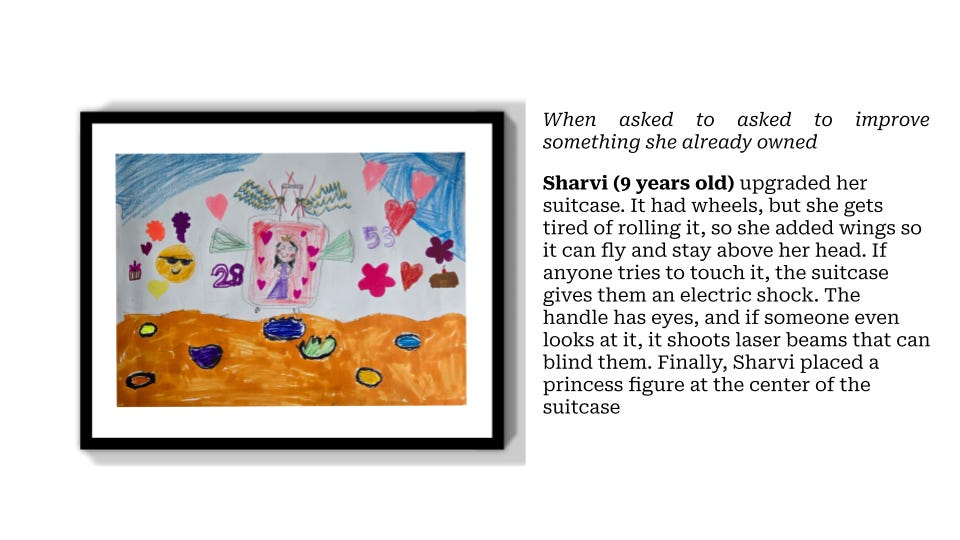
Take an object you own and add new powers to it.
When the sessions first began, and children were asked to draw without a reference, the reactions were predictable: “I don’t know how to do it,” “Give us something to look at,” “It’s not possible.” The initial hesitation made sense; drawing without a reference was new territory for many of them.
What is important here is that I do not teach them how to draw. There is no lesson on technique, no pressure to make things look beautiful, realistic, or neat. The expectation of “good drawing” is removed entirely so that thinking can take centre stage. Children are free to use simple shapes, symbols, stick figures, or any visual language they are comfortable with. This removes a major barrier and allows every child to participate fully, regardless of their drawing ability.
When children begin creating from scratch, the exercise becomes about far more than just art. Gradually they learn to recognize their own thoughts and ideas and to trust them. Even for most adults, this can be rather difficult to do. We constantly look outside of ourselves for validation and in the pursuit lose our ability for creative and original thought. As they put down their ideas on the blank canvas, the children must work past their own fears of judgement and focus instead on the ideas and thinking that is taking shape. As they stop depending on references, they gradually start to discover that they already have enough inside them to create something original. This realization makes them more curious, more open to wondering, and more confident in their own thinking.
In a world where references are everywhere - templates, tutorials, even AI - ability to start with your own idea, stay with it, revise it, and explain what you meant becomes even more important. That’s what spaces like Ikpreet’s art space is trying to protect.
Children are practicing creative and critical thinking - they’re imagining possibilities, making choices, and giving reasons for them. And because it happens in a shared room, those ideas don’t stay private: children learn to communicate what they mean, collaborate through questions and feedback, and listen closely enough to respond with care. Over time, this also builds something deeper: confidence (“my ideas matter”) and agency (“I can shape something from my own thinking”) - the foundations of real problem-solving.
We may not know what kind of work Anika will do 15 years from now. But we do know she’ll need these capacities to thrive in an uncertain world: to think originally, work with others, stay reflective, and keep finding her way.
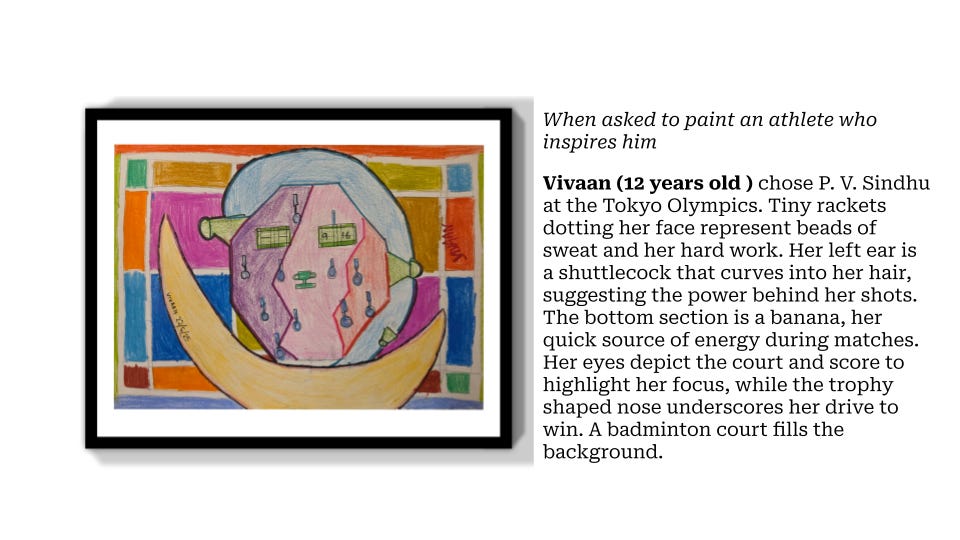
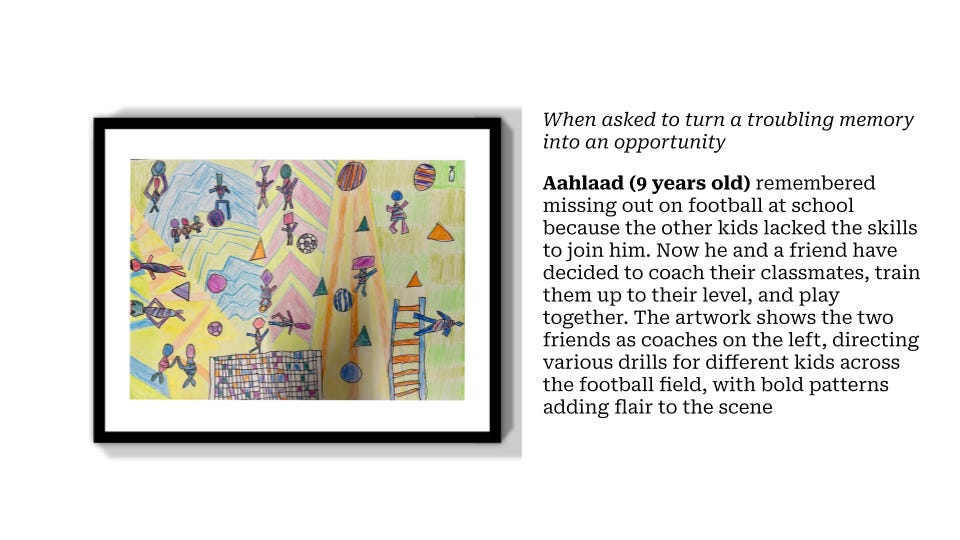
Below, are three art pieces and their descriptions given by the artists themselves:
Week on week, there is a shift. Children who once rushed to finish or who kept seeking validation - now pause, think, review their work midway, and even choose to change things when ideas evolve. Stopping, rethinking, and revising feel natural as they feel ownership over their work.
Making thinking visible
The real magic happens when children explain their artwork.
Art sessions explained by Ikpreet (Contd.)
Day two is about making and finishing. Children return to their work, add layers, colour if they want to, refine their ideas, or even change direction altogether. The session ends with a simple showcase. Each child shares what they have made, why they made it, and what they were thinking. Peers ask questions, challenge ideas, and offer reactions.
No one is evaluating the work based on symmetry, beauty, or how closely it resembles a reference. There is no comparison of who drew better. Instead, the focus is on ideas. Children want to share what they thought of, what they imagined, and what they built from scratch
Initially, when the children were asked to explain their artwork, most of them found it rather difficult to do. They felt shy and uncertain of the choices they’ve made. However, gradually, the pressure loosens. They have grown to love explaining their creations, telling the stories behind them, and showing how they think. What may first appear as a messy drawing becomes a coherent story full of meaning, humor, and thought. The excitement to share, has strengthened their verbal expression and storytelling as they find the most compelling ways to communicate their ideas to others.
Here’s a sneak peek into the thinking behind the drawing: Vivaan describing his artwortk to Ikpreet during the session
While there is the individual’s growth, there is a collective growth too for the group. There is a shift in the way they engage with each other: they collaborate more, help each other, debate respectfully, disagree without conflict, and defend their ideas thoughtfully.
Ikpreet’s reflections
Parents tell me that their children continue these conversations at home, sharing stories of what they made, why they made it, and what they discussed in class. They share that these sessions have become windows into their children’s thinking. The stories and ideas that surface during these activities reveal emotions, concerns, hopes, logic, and humor that parents were unaware of. They begin to see their child not just as a student but as a thinker and a creator.
This realization for parents too has happened rather gradually. Initially they would respond to children’s art work with basic responses such as ‘Great work”, “Good job”, etc. But here, too, Ikpreet’s experiments have borne fruit. In an attempt to get parents to take deeper notice, he asked parents to share some problem statements they’re facing and want to resolve. “How can I reach the office faster? Laundry is too much to be folded, My kid demands different food every meal and it is very difficult to make.” The sessions that followed revolved around kids attempting to solve these problems for their parents, and to use art to depict their solutions.
This started off a chain of dialogue at home. These experiments have gradually made the child’s thinking visible to both the child themselves and to the parents whose validation and support they inevitably seek and need.
What these experiments teach us about learning
These stories and experiments are case studies in how learning habits are formed, reinforced, and eventually internalised. From an early age, many learners are trained to rely on external references, benchmarks, and judgements to evaluate themselves. Over time, this shapes how they approach not just art and drawing, but thinking itself.. hesitantly, fearfully and with a constant need for approval. What Ikpreet’s experiments demonstrate is that this pattern is not fixed. When references are removed, outcomes are deliberately left open, and when explanation is valued more than perfection, learners begin to operate differently, generating nuanced and original ideas instead of reproducing them. They learn to be comfortable with ambiguity, test possibilities, revise their thinking, and articulate intent. These are not simply art-based skills; they are in fact foundational cognitive skills.
This approach has relevance across disciplines. Whether in science, humanities, problem-solving, or leadership, the capacity to frame questions, construct meaning, and communicate reasoning matters more than surface-level correctness. Ikpreet’s work is further suggestive that meaningful learning design does not require complex tools or radical restructuring. It requires clarity about what we are optimising for. Small shifts such as changing the nature of prompts, withholding premature judgement, making thinking visible through dialogue, can significantly alter how learners engage with knowledge.
The most important outcome here is not “better” drawings. It is learners who recognise their own thinking as valid raw material, who can explain and defend ideas, and who are comfortable revising them. In a world where answers are increasingly accessible, the ability to think independently, explain clearly, and engage thoughtfully may be the most transferable learning outcome of all.
Ikpreet’s reflection on his approach & pedagogy!
As a facilitator of this space, one of my biggest temptations is to get involved and control what’s happening - to keep telling children to do things the way I’m imagining it in my head. But over this past year, the biggest thing I’ve learnt (and started practicing) is to step away after the initial interaction. To pause. To Listen. To Observe. To let children be. I’ve realized - The more I stay inside the process, the more I end up - directly or indirectly - placing my thinking onto theirs, and that can quietly limit what might have emerged. When I move away, I see something else happen: they surprise me, and they surprise each other. Their creativity becomes fuller because there are many minds working freely, instead of one adult mind shaping the direction.
This is deeply aligned with The Observation Project - that learning takes time, and children need space to stay in the driving seat of their own learning. For me, that means restraint: observing the learners, but also observing myself. Noticing when my interruptions are coming from my bias, my impatience, or my need for things to look a certain way and choosing, again and again, to pause instead. Of course, I do engage when they come with doubts, questions, or when they ask to brainstorm - but even then, I try to let it be led from their side. Otherwise, I step back, because that’s when the real creativity shows up and more importantly, that’s when the real them comes out.
This is what the Observation Project is really about: Learning about Learning by staying close to children, and then carrying those insights back into our classrooms, homes, and learning spaces. This post feels special because Ikpreet shows what it looks like to treat children’s thinking with real respect - to meet them as equals, to give their ideas high status, and to step back so learning can take its time. You can see it in their artwork: when children aren’t rushed or shaped too quickly, something opens up. They begin to trust their own instincts, and that’s where the magic comes from. If you’re experimenting with practices that protect children’s thinking, we’d love to learn from you.
Write to us at theobservationproject@gmail.com with what you’re trying, what you’re noticing, and what you’re still wondering.
Thanks for reading! Subscribe for free to receive new posts and support my work.
This piece captures something fundamental about learning: the shift from performance to authorship. The movement from “How’s this looking?” to “Look, I made this” is not a small pedagogic detail — it signals a deeper transfer of ownership.
What stands out to me is the discipline of restraint. The decision to pause, to withhold judgement, to privilege explanation over appearance — that is where the real work is happening. When adults resist the urge to correct or beautify, children begin to construct internal standards rather than chase external approval. That is how agency forms.
The story is powerful. It might become even stronger if the underlying learning moves were named more explicitly — the cultivation of risk, revision, reflective dialogue, and comfort with ambiguity. These are not art skills; they are capacities for life.
I am also left wondering: what conditions allow such spaces to endure beyond small groups? If we are serious about nurturing thinking rather than compliance, then the structures around classrooms must also align with this ethos.
When adults step back with intention, children do not become directionless — they become responsible for their own ideas. That is a shift worth protecting.







This piece captures something fundamental about learning: the shift from performance to authorship. The movement from “How’s this looking?” to “Look, I made this” is not a small pedagogic detail — it signals a deeper transfer of ownership.
What stands out to me is the discipline of restraint. The decision to pause, to withhold judgement, to privilege explanation over appearance — that is where the real work is happening. When adults resist the urge to correct or beautify, children begin to construct internal standards rather than chase external approval. That is how agency forms.
The story is powerful. It might become even stronger if the underlying learning moves were named more explicitly — the cultivation of risk, revision, reflective dialogue, and comfort with ambiguity. These are not art skills; they are capacities for life.
I am also left wondering: what conditions allow such spaces to endure beyond small groups? If we are serious about nurturing thinking rather than compliance, then the structures around classrooms must also align with this ethos.
When adults step back with intention, children do not become directionless — they become responsible for their own ideas. That is a shift worth protecting.
What a wonderful read! I am sharing this with parents in my circle. So much for all of us to learn from. Thank you❤️